3D model of ceramic container replicas from the late Minos I period

3D model of ceramic container replicas from the late Minos I period

It is a replica from the late Minoan period of Crete (approximately 1700-1450 BC). This pottery is famous for its unique decoration, with patterns of double axes and lilies engraved on it. The double axe is an important symbol in Minoan culture, often associated with religious rituals and power, while the lily flower may symbolize purity or rebirth. This replica showcases the exquisite craftsmanship and artistic beauty of ancient Cretan pottery, providing us with a valuable window to understand ancient civilization, religious beliefs, and daily life.
Late Minoan period II to III ceramic containers

Late Minoan period II to III ceramic containers

It is an ancient Greek ceramic container characterized by a unique decorative style, often associated with palace workshops in Crete. This style of pottery appeared during the late Minoan period II to III (approximately 1450 BC to 1100 BC) and is representative of the late Minoan civilization. Known for its exquisite decorations, especially the papyrus flower patterns depicted above, these decorations not only showcase superb craftsmanship but also reflect the culture and aesthetics of the society at that time. The prototype was discovered in Knossos, which was one of the centers of the Minoan civilization. It is a valuable resource for studying ancient Mediterranean world trade and cultural exchanges.
3D model of a replica of a Minoan period fancy style water bottle
3D model of a replica of a Minoan period fancy style water bottle

It is a replica of an animal shaped outlet, based on the Late Minoan period of Crete from 1700 BC to 1450 BC. It is practical and reflects people's appreciation of art and natural forms at that time. The design is usually complex and the decoration is exquisite, reflecting the highly developed ceramic craftsmanship technology at that time. The animal shaped water outlet not only enhances the aesthetics of the kettle, but may also have symbolic significance, such as expressing worship of nature or being related to mythological stories. The production of replicas aims to inherit and showcase the artistic achievements of ancient civilizations, allowing modern audiences to appreciate the exquisite craftsmanship of ancient craftsmen up close
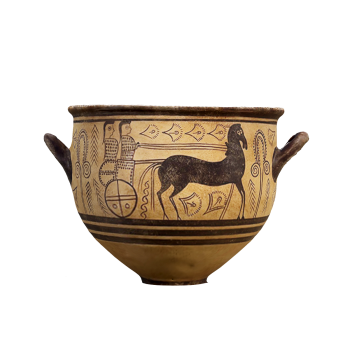
Late Mycenaean civilization ceramic containers

Late Mycenaean civilization ceramic containers

It is a decorative style of Greek pottery from the late Mycenaean civilization (around 1400 BC to 1100 BC), characterized by the depiction of narrative scenes on pottery, usually themed around chariots, soldiers, animals, or mythological stories. Produced by an artist working in Mycenae, Greece, decorated with a row of confident soldiers marching forward. Featuring a wide top opening, low handles on both sides, and a narrow circular base. The decorative style reflects the artistic tradition and aesthetic taste of the Mycenaean civilization. Despite experiencing turbulence in the last few centuries of Mycenaean civilization, artists were still able to create exquisite pottery works.
3D model of Mycenaean civilization double ear bottle replica

3D model of Mycenaean civilization double ear bottle replica

It is a double eared vase depicting a bull and stylized flowers, which is a replica from the Mycenaean/Late Hittite III period (1400-1100 BC) in Cyprus. This type of double ear bottle was used at that time for storing and transporting food, such as wine and olive oil. The design originated from large storage containers in the Bronze Age, which later became one of the most common shapes of ancient pottery. The Mycenaean civilization was an important stage of ancient Greek civilization, and the late Hittite III period was the late stage of this civilization. During this period, Cyprus had close ties with the Mycenaean civilization.
Kamares style pottery replica 3D model

Kamares style pottery replica 3D model

It is a type of pottery in the Kamares style, which is closely related to the palace culture of the Minoan civilization and was mainly popular during the Middle Minoan period from 2100 BC to 1550 BC. Known for its abstract curved designs with sharp black and white contrasts and stylized plant and marine life patterns, which are typically painted in white, red, orange, and yellow on a black background. The production is very delicate and requires completion on high-speed rotating ceramic wheels, which is a new invention of the Middle Minoan era. This pottery jar features a rose decoration pattern and a relief of "eyes", which is a replica of the Middle Minoan period in the Festus region.
3D model of Italian red painted double ear bottle replica

3D model of Italian red painted double ear bottle replica

It is a work imitating the 4th century southern Italian red painted double ear vase. The bottle depicts Hymelos and Eros coronating Odia. It showcases characters from ancient Greek mythology and also reflects the profound understanding of emotions and virtues in ancient art. The red painting technique of this double eared bottle is very exquisite. It is made by coating the surface of the pottery with red pigment, depicting characters and patterns, and finally applying transparent glaze and firing it. This technology makes the work colorful, vivid, and has high artistic and historical value. It is a precious artwork that combines ancient Greek mythology, artistic techniques, and cultural connotations. Showcasing the superb skills of ancient artists
Carrefour Cup replica 3D model

Carrefour Cup replica 3D model

It is a replica Kamares pottery "eggshell cup" with spiral patterns, characterized by a Carrenat outline. It imitates artifacts from the Middle Minoan period (approximately 1900 BC to 1700 BC). Kamares pottery is a type of pottery unique to the Minoan civilization, known for its exquisite craftsmanship and delicate decoration. The characteristics are thin walls, smooth surfaces, and complex geometric patterns. The replica of the Karenat Cup is a tribute and commemoration to the ancient Minoan civilization. Not only does it showcase the exquisite craftsmanship of ancient civilization, but it also allows us to glimpse the culture and aesthetics of that era.
Etruscan pottery jars - Castello Banfi collection

Etruscan pottery jars - Castello Banfi collection

It refers to Etruscan pottery jars. The Etruscan civilization was an ancient civilization that existed in the central part of the Italian peninsula from the 8th century BC to the 1st century BC. The Etruscan pottery jar is a typical pottery of this civilization period, with a unique artistic style and craftsmanship. The pottery jar from Castello Banfi's collection is made of brown coarse clay, which was very common in the production of coarse pottery in the late Iron Age, around the 8th to 7th century BC. This pottery jar was unearthed in Montalcino as a relic of the Etruscan civilization, showcasing the exquisite craftsmanship and aesthetic features of ancient pottery.
Duck shaped ceramic container

Duck shaped ceramic container

Ceramic containers with duck like features were very popular in ancient Peruvian culture, especially during the Mochica culture period. The Mochika culture existed approximately between the 1st century and 800 AD, and its artistic works are renowned for their intricate sculptures and paintings, reflecting the social life, religious beliefs, and agricultural activities of the time. During this period, ceramic art experienced significant development, resulting in many representative works. Not only as daily necessities, but also as works of art, showcasing the craftsmanship and aesthetic style of the time. This ceramic container returned from the United States in 2022.
Maiolica Medicine Jar - Hunter Museum in Limerick, Ireland

Maiolica Medicine Jar - Hunter Museum in Limerick, Ireland

Also known as albarello, it is a ceramic container with a long history. Made of Maiolica material, it has a cylindrical shape with a slightly contracted waist, gradually narrowing at the bottom and neck, and curling outward at the mouth. The decoration is very exquisite, with blue as the main color tone and various floral patterns painted. The central position is engraved with the inscription "COMM7", which is related to the purpose or contents of the medicine jar. The decorative style is similar to the medicine cans imported from Spain in the 15th century, indicating that it may have been influenced by trade and cultural exchanges at that time. The Hunter Museum in Limerick, Ireland, is a precious heritage of ceramic art and decorative art.
Frog shaped ceramic container

Frog shaped ceramic container

This frog shaped container has its body carved into a crouching posture, with a handle and water outlet on its back. Decorated with black, yellow, brown, and red paint, with horizontal black lines on the surface to represent the rough skin of frogs. The dots on the back and chin may represent the markings of the Marangon Poison Frog, named after the toxic chemicals it secretes as weapons against predators. The strong substance secreted by Poison Arrow Frog has also been used as medicine. Usually lives in rainforests, near rivers and lakes. Due to the destruction of its natural habitat, the Malan Weng Poison Frog is considered an endangered species.
ParrotEffigy parrot shaped container

ParrotEffigy parrot shaped container

It is an ancient American artwork inspired by parrots. This container is shaped like a parrot, with its tail feathers cleverly designed as a practical outlet. In ancient American art, parrots held significant symbolic importance. For example, in Mexican tradition, parrots symbolize fire and the sun due to their bright feathers. This work not only showcases the creativity and craftsmanship of ancient artists, but also reflects their profound understanding and reverence for the forces of nature and the universe.
CopticVessel Ancient Egyptian Coptic pottery - Metropolitan Museum of Art

CopticVessel Ancient Egyptian Coptic pottery - Metropolitan Museum of Art

It is a pottery from the Coptic period in Egypt, belonging to the cultural product of the Byzantine Egyptian period. Produced in the 4th to 7th centuries, specifically in the Kaga Oasis of Egypt. Made of homemade materials, it belongs to the category of ceramic artworks. This artwork is currently housed in the Metropolitan Museum of Art and is part of the medieval art and monastery collections. It showcases the artistic style and ceramic production techniques of the Copts at that time, providing valuable physical evidence for us to understand the culture and lifestyle of this period.
Cup shaped ceramic container - Bonn Collection of America

Cup shaped ceramic container - Bonn Collection of America

The cup-shaped container in the Bonn Collection of America is a pottery with a unique shape and color. This container is cup-shaped and coated with red and black pigments on the surface, with vivid colors and visual impact. Originating from the Canelo region of Ecuador, it was collected by Erich Wustmann and included in his personal collection. Not only is it a practical drinking vessel, but it also reflects the artistic and cultural characteristics of pottery making in ancient Ecuador. The combination of red and black may be related to local religious beliefs or social customs, reflecting the aesthetic concepts and lifestyle of ancient residents.